First help desk for SaaS startups moving past a shared inbox
The first help desk for SaaS startups should make support calmer without turning your team into an enterprise support department. Muninx helps SaaS teams assign ownership, track response times, keep customer conversations organized, and use AI-assisted drafts when human agents need help.
Quick answer
Muninx is best for
Muninx is best for SaaS startups that already have a support queue inside a shared inbox and now need owners, priorities, reporting, and cleaner customer history.
A good time to switch
Switch when support@ has become the place where bugs, billing questions, onboarding issues, and customer requests all compete for attention without clear ownership.
Main tradeoff
Muninx gives SaaS teams a real help desk without enterprise-suite complexity. The tradeoff is that it does not offer a knowledge base or live chat today, so it fits best when email-based ticketing is the immediate problem.
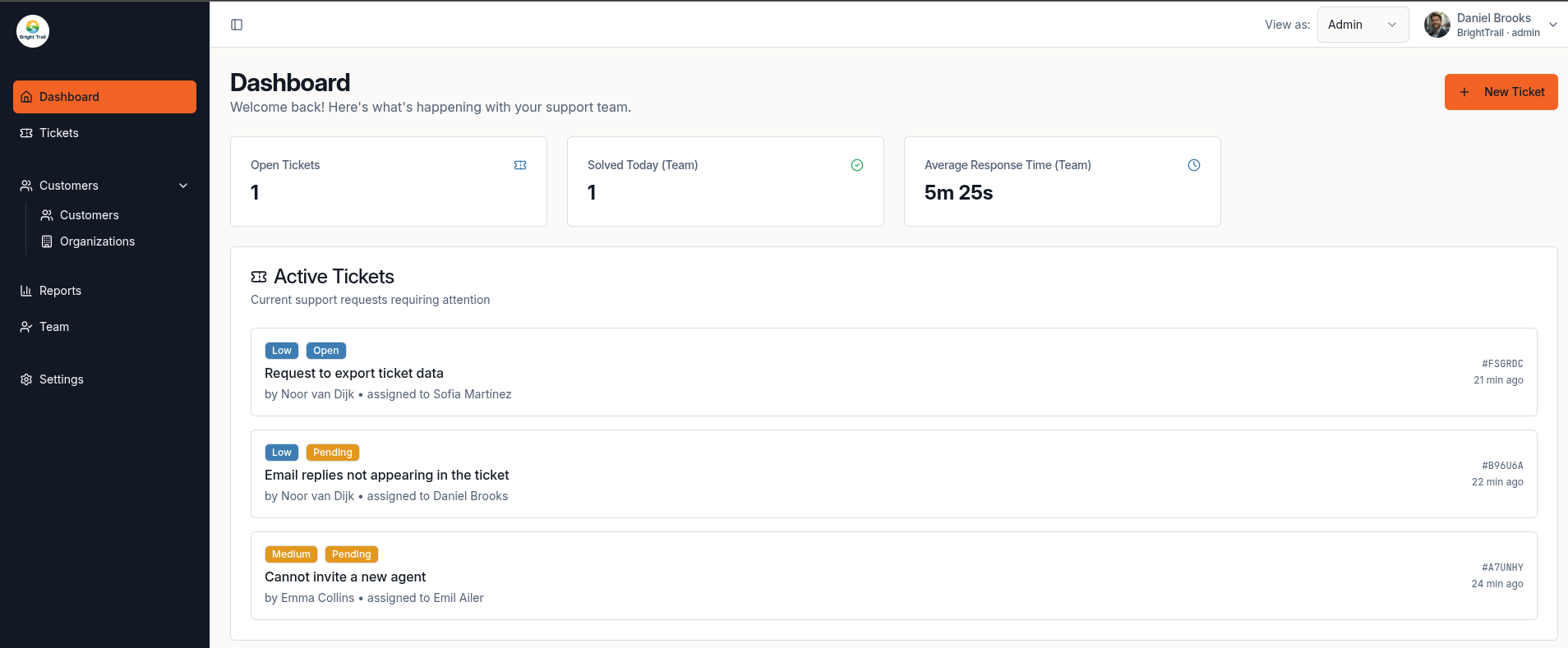
Real product view
A first help desk that shows the queue clearly
A real Muninx dashboard view showing active tickets, response metrics, and support workload for teams moving beyond a shared inbox.
What startups should look for in a help desk
The best help desk software for startups should remove inbox chaos without forcing a small team into enterprise-style setup work.
Page last reviewed on May 18, 2026.
Product, competitor pricing, and feature information can change. Always verify the latest information on the vendor's official website.
| Category | What startups usually need | How Muninx fits |
|---|---|---|
| Best for | A first help desk should fit a small SaaS team that is still founder-led or support-generalist-led, not a large support organization. | Muninx is built for startups, small businesses, and lean support teams moving from shared inbox handling into structured ticket work. |
| Starting price | Early SaaS teams need pricing that makes sense before support volume is predictable. | Muninx includes 1 free human agent forever. Additional human agents cost EUR 9 per agent per month, and AI-assisted agents cost EUR 17 per agent per month. |
| Ease of setup | The first tool should be quick to adopt because the team usually does not have a dedicated support operations owner yet. | Muninx focuses on practical ticketing, assignments, priorities, dashboards, and reports instead of a long enterprise rollout. |
| Ownership | A SaaS support queue needs a clear owner for each customer conversation so teammates stop replying over each other or assuming someone else has it. | Muninx supports ticket assignment and assignee management so ownership is visible inside the queue. |
| Response-time visibility | Founders and support leads need to know whether customers are waiting too long, especially during onboarding, renewal, and incident moments. | Muninx includes reporting and dashboards for response time, resolution, ticket status, priority, customer, and agent visibility. |
| AI features | SaaS teams often want AI to reduce drafting work while keeping customer replies reviewed by a human. | AI-assisted agents include AI draft replies, response improvements, web-source context, and admin-defined instructions. Human agents stay in control of what gets sent. |
| Knowledge base | Some SaaS teams eventually need self-service content for repeated setup, billing, and troubleshooting questions. | Muninx does not offer a knowledge base today, so it is not the right first choice if self-service documentation is the immediate priority. |
| Live chat | Some SaaS teams want real-time support inside the product or on the website from day one. | Muninx does not offer live chat today. It is a better fit for teams that want to organize email-based customer conversations first. |
| Pricing predictability | A startup help desk should not force a small team into hard-to-forecast platform, add-on, or usage math too early. | Muninx separates human agents from AI-assisted agents clearly: 1 free human agent forever, EUR 9 additional human agents, and EUR 17 AI-assisted agents. |
Need a clean upgrade from a shared inbox?
Start free, review pricing, or go back to the main product overview before your team commits.
When startups outgrow a shared inbox
Shared inboxes work for a while. The problem starts when support volume grows faster than ownership, process, and visibility.
Your shared inbox is already a support queue
It just does not have owners, priorities, or reporting. Once customer conversations are spread across bug reports, onboarding questions, billing issues, and renewal risks, the inbox is doing help desk work without help desk structure.
Ownership becomes unclear as soon as support is shared
A founder can manage early customer emails from memory. A SaaS team cannot rely on memory once product, sales, success, and support all touch the same customer thread.
Customer context gets scattered
SaaS support is rarely just one email. Customers have organizations, previous requests, open tickets, and account-specific context that should be easier to find than searching an inbox.
Response times start to matter before you hire a support team
Early SaaS companies often notice the support problem when prospects, trial users, and paying customers are all waiting in the same queue. That is the moment reporting and assignments become operational, not cosmetic.
Why Muninx works for lean teams
Muninx is built for startups that want a real support workflow without a long buying cycle or a bigger tool than they need.
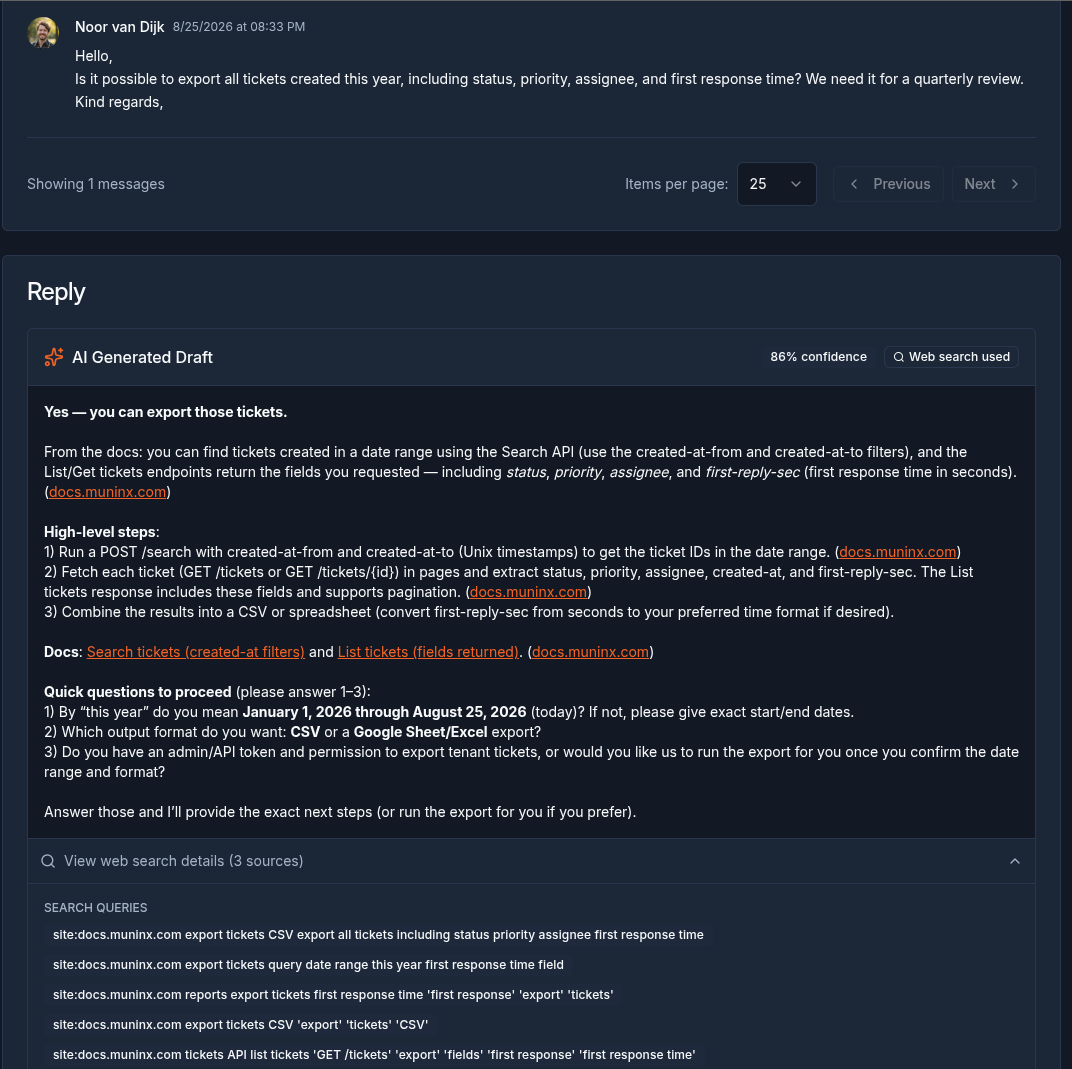
AI-assisted replies
Draft faster without removing human review
A real Muninx ticket view with an AI-generated draft reply for an AI-assisted agent. Human agents still review what gets sent.
It is built for the first real support workflow
Muninx gives SaaS teams ticketing, assignments, priorities, customer records, organization records, dashboards, and reporting without making the team adopt a broader enterprise support suite.
It keeps the shared-inbox upgrade practical
The point is not to overbuild support operations. The point is to stop losing ownership, waiting time, and customer history inside a shared inbox while keeping the team moving.
AI-assisted replies are available seat by seat
SaaS teams can keep standard human agents on the human-agent plan and choose AI-assisted agents only for teammates who need drafting help. AI assistance is not required for every user.
Pricing stays easy to explain
Muninx starts with 1 free human agent forever. Additional human agents cost EUR 9 per month, and AI-assisted agents cost EUR 17 per month. The free human agent has the same standard capabilities as paid human agents.
You can review the public product overview on the features section or go straight to pricing if cost and team fit are the main decision points.
Illustrative SaaS scenario
A SaaS startup turns support@ into an accountable queue
Imagine a small B2B SaaS team where support@ receives onboarding questions, bug reports, password issues, billing requests, and expansion conversations. The inbox looks manageable until several teammates are checking it at different times.
The startup gets the first layer of support operations it actually needs: ownership, organization, reporting, and optional AI assist without committing to a heavier enterprise suite.
Before
No one can tell at a glance which teammate owns each customer conversation.
Urgent product issues sit next to routine account questions.
Response-time patterns are invisible until a customer complains.
The team rewrites similar replies instead of starting from a useful draft.
After moving to Muninx
Each customer conversation becomes a ticket with ownership and priority.
Founders and support leads can review response and resolution patterns.
Customer and organization records help the team understand context faster.
AI-assisted agents can draft replies while human agents decide what to send.
Who should choose Muninx
SaaS startups moving from support@, Gmail, Outlook, or a shared inbox into their first help desk.
Founder-led and lean support teams that need owners, priorities, response-time tracking, and customer conversation history.
Teams that mainly support customers by email today and want ticketing before they buy live chat or a self-service platform.
SaaS companies that want a permanent free human agent, predictable paid human seats, and optional AI-assisted agents.
Who should wait or look elsewhere
You need a knowledge base as the first project
Muninx does not offer a knowledge base today. If your immediate goal is public documentation or self-service articles, choose a tool built around that workflow.
Live chat is the core support channel
Muninx does not offer live chat today. If your SaaS support motion depends on real-time in-app chat, start with a chat-first platform instead.
You already need enterprise support operations
If you need advanced routing, complex SLAs, voice, workforce management, or deeply specialized enterprise workflows, Muninx is intentionally not trying to replace that kind of suite.
FAQ
Short answers for startups evaluating whether it is time to move on from a shared inbox.
Give your SaaS support queue real ownership
Start free with Muninx and move from shared-inbox support to tickets, assignments, response-time visibility, and optional AI-assisted replies.
We value your privacy
We use cookies to enhance your browsing experience and analyze our traffic. By clicking "Accept All", you consent to our use of cookies.